


















Can a Fiber Welder Machine Really Handle High-Precision Jobs Without Constant Manual Adjustments?
Precision is everything in metalwork—especially when industries demand speed, accuracy, and long-term reliability. But one tool has quickly risen through the ranks as a modern solution: the fiber welder machine. Despite its compact design and user-friendly controls, a common question remains—can this machine truly deliver precision work without ongoing manual tweaks?

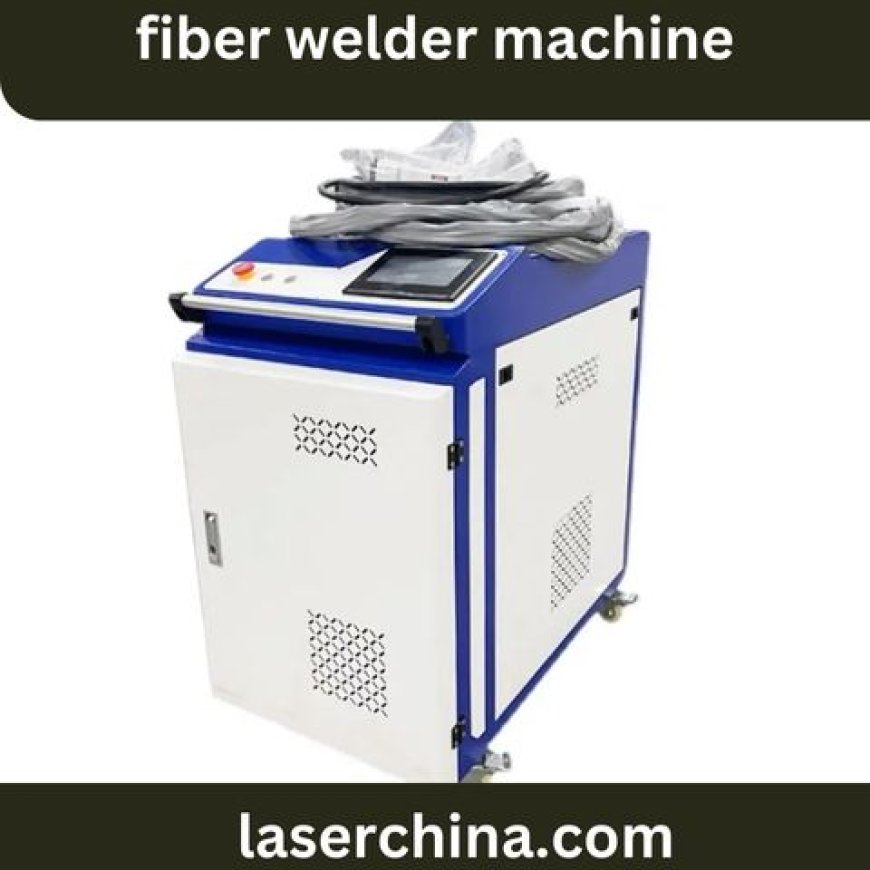
To answer this, we need to look beyond surface-level promises and understand how a fiber welder machine actually works in real-life conditions, how it maintains accuracy, and how it has evolved to become a dependable asset for workshops and manufacturing setups worldwide.
Understanding the Working Principle of a Fiber Welder Machine
A fiber welder machine operates using a fiber laser source, which generates a highly concentrated beam of light. This beam, directed through a fiber optic cable, creates a very narrow, highly focused point of heat capable of melting metal at the microscopic level. The process is largely automated and finely controlled through software, sensors, and pre-set configurations.
What makes this approach different from traditional arc or TIG welding is the way energy is delivered. Instead of relying on a broad arc or filler material, the fiber laser beam penetrates and fuses metal with minimal distortion and superior control.
The system doesnt need repetitive manual calibration because most fiber welder machines are designed with automatic power regulation, beam focus adjustment, and real-time feedback systems. As a result, the operator sets the job parameters once, and the machine handles the rest.
Applications Where Precision Is Critical
To understand whether the machine truly holds up without constant adjustment, its worth looking at some environments where precision cant be compromised:
-
Medical Device Manufacturing: In the production of stainless steel surgical tools or implantable devices, precision welds are critical. Any inaccuracy can lead to failure or rejection.
-
Battery Pack Assembly: For lithium-ion battery packs, especially in electric vehicles, fiber welder machines offer the clean, non-contact welding required for thin metal connections.
-
Microelectronics: Welding tiny components, such as sensors and contacts, requires accurate beam control that only a fiber welder can consistently maintain.
Each of these sectors depends on repeatable, accurate welds. In all these cases, operators dont spend their time readjusting or correcting the machine mid-process. Instead, the consistency of the welds is maintained through pre-programmed welding paths, and internal sensors ensure ongoing stability during operation.
How Modern Fiber Welder Machines Minimize Manual Intervention
Its not just theoryseveral features of the modern fiber welder machine contribute to its hands-off precision.
-
Auto-Focus Capabilities
The laser head adjusts the focal length automatically based on material thickness. This eliminates guesswork and ensures consistent weld penetration. -
Real-Time Feedback Loops
Embedded sensors measure laser output, temperature, and focus to adapt settings dynamically. These adjustments are instant and remove the need for manual tweaking. -
Programmable Settings and Memory Functions
Fiber welders allow users to save welding recipes. Once tested and saved, these parameters can be reused for future jobs without needing recalibration. -
Cooling System Integration
Thermal regulation ensures the machine remains within optimal operating conditions. Without overheating or thermal drift, welding quality remains consistent. -
Protective Housing and Safety Interlocks
These features dont just improve safetythey preserve the internal alignment and cleanliness of optics, which directly affects precision.
Operator's Role: Minimal But Essential
While the fiber welder machine handles much of the technical side, operators still have a vital role. Their job has shifted from reactive (adjusting parameters mid-weld) to proactive (setting up jobs with correct values, checking calibration before starting). Once the machine is running, it seldom requires interruptions unless materials change or an error occurs.
This shift allows even small workshops to increase productivity. One operator can oversee multiple fiber welding stations without compromising quality, making the entire operation more cost-efficient and streamlined.
Realistic Maintenance vs. Continuous Adjustment
Theres a difference between routine maintenance and continuous adjustment. All machines require upkeepcleaning optics, inspecting fiber cables, and software updatesbut these tasks are scheduled, predictable, and non-intrusive. They dont interfere with job-to-job consistency or day-to-day performance.
Fiber welder machines are engineered to perform thousands of welding cycles with consistent output. Their fiber optic delivery systems are enclosed, reducing exposure to dust and debris, and the solid-state laser sources have life spans that exceed 100,000 hours in many models.
So when people ask if they require frequent tweaking to maintain precision, the answer is nonot in the hands of a responsible operator following standard maintenance schedules.
Common Misconceptions That Create Doubts
One reason for this question even existing is the prevalence of myths surrounding laser technology. Some fabricators still believe:
-
Fiber lasers cant handle reflective materials like aluminum or copper reliably.
-
They require expert-level programming to operate.
-
Frequent refocusing is necessary for varying material thicknesses.
All of these concerns are outdated or based on early models. Todays machines offer automatic calibration, deep penetration settings for reflective metals, and even touchscreen interfaces with guided workflows. Anyone with basic training can manage these machines effectively without constant supervision.
The Financial Logic Behind Hands-Free Precision
In high-output environments, downtime due to manual adjustments can mean lost revenue. Fiber welder machines deliver long-term cost savings by avoiding that downtime:
-
Less Scrap Material: Precision reduces weld errors and rejected parts.
-
Fewer Man-Hours: No need to station skilled welders for every job.
-
Consistent Output: Predictability helps maintain client trust and process certification.
This operational stability turns the machine from a capital expense into a profit-generating asset in a relatively short time.
Scaling from One-Off Jobs to Full Production
Whether it's a custom repair job or high-volume production, a fiber welder machine adjusts accordingly. Its scalability doesnt rely on manual processesits governed by its software architecture and hardware design.
You can switch between different metal types and thicknesses by loading the right program and replacing the material. No need to change lenses, recalibrate focus manually, or babysit the system throughout.
This makes fiber welder machines ideal for growing shops that aim to expand without hiring a larger team of skilled welders.
Why the Question Matters
Asking whether a fiber welder machine can handle precision work without constant manual adjustments is a valid concernespecially for businesses transitioning from manual welding systems or traditional arc welding. But the answer lies in technology progression.
Fiber laser systems have matured to a point where consistency, reliability, and precision are built-in. When properly used and maintained, they require far less hands-on involvement than most legacy systems. And thats not just a benefitits a transformative change in how welding is approached in the modern manufacturing world.
Final Thoughts
The fiber welder machine isnt just another toolits a leap forward in precision welding technology. It handles delicate and complex welding tasks with unmatched consistency, and it does so without demanding continuous manual adjustments. Through its intelligent systems, software precision, and robust hardware design, it proves that accuracy no longer needs to be babysat. For workshops seeking dependable output with minimal hands-on correction, investing in a fiber welder machine is a decision that pays for itself in time, quality, and efficiency.