





















Transform Financial Analysis with Automated Financial Spreading
Is your organization under pressure to deliver faster, more accurate financial insights without sacrificing compliance or control? In the face of growing data volumes and increasingly complex financial statements, analysts, credit teams, and risk officers are turning to a game-changing approach: automated financial spreading.
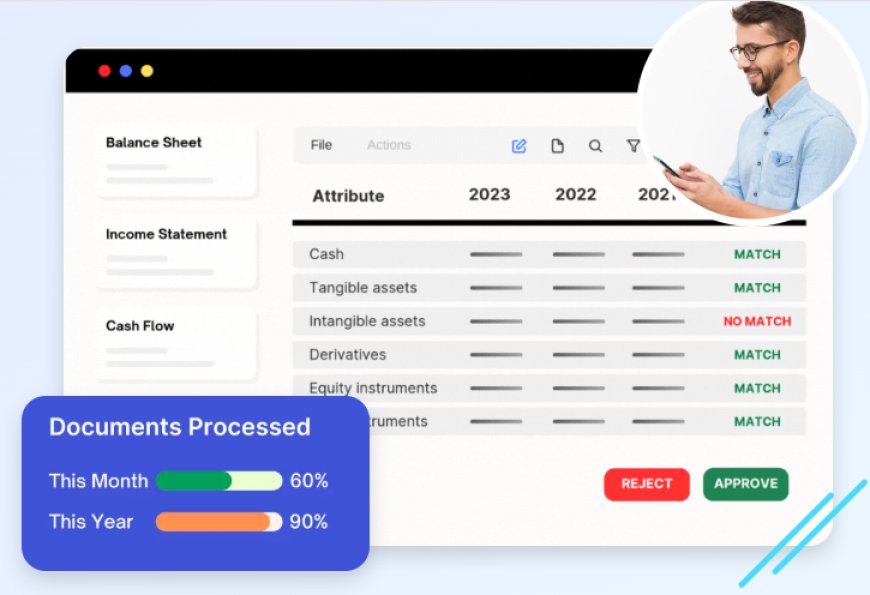
Is your organization under pressure to deliver faster, more accurate financial insights without sacrificing compliance or control? In the face of growing data volumes and increasingly complex financial statements, analysts, credit teams, and risk officers are turning to a game-changing approach: automated financial spreading.
This blog explores how automated financial spreading transforms the financial analysis process. From document ingestion and reconciliation to ratio analysis and dashboard integration, we will outline how automation improves speed, consistency, and decision accuracy while fully aligning with the services currently offered in advanced financial document intelligence platforms.
Why Financial Analysis Needs Automation
Manual processes in financial analysis are no longer sustainable. Time-consuming data entry, inconsistent formatting, and high risk of error make traditional workflows inefficient. Automated financial spreading eliminates these challenges by using machine learning models to recognize and categorize financial data, regardless of how it is presented.
Automation classifies and maps financial data from scanned PDFs to unstructured reports into predefined templates. This allows analysts to focus on interpretation and insights rather than spending hours on data cleanup.
Document Ingestion and Standardization
The capacity to process a variety of input formats is a critical component of automated financial spreading. The system accurately extracts line items whether documents are uploaded in PDF, image, or multi-column layout. It classifies them by category such as current liabilities, net income, or total equity.
Once extracted, data is normalized into a consistent format across borrowers, industries, and periods. This level of standardization is essential for accurate peer comparisons, trend analysis, and portfolio monitoring.
Reconciliation and Accuracy Controls
Accurate financial analysis depends on consistent, reliable data. Automated platforms include built-in reconciliation features that cross-check line items across statements. For example, retained earnings from the balance sheet are automatically reconciled against income and dividend entries.
This automated reconciliation ensures that automated financial spreading produces complete and accurate results. It also supports audit readiness and regulatory compliance by offering traceable records of how financial data was sourced and structured.
Real-Time Ratio and KPI Calculation
Once financial statements are structured and validated, analytics tools take over. Automated platforms calculate real-time financial ratios such as liquidity, leverage, coverage, and profitability. These metrics are critical for assessing creditworthiness, identifying risk, and supporting underwriting decisions.
Embedding these analytics directly into the automated financial spreading process enables faster, more data-driven decisions across lending, investment, and enterprise risk functions.
Portfolio-Wide Insights and Dashboards
For organizations managing large credit or investment portfolios, visibility across all financial data is essential. Centralized dashboards allow analysts and risk officers to track spread completion, review key ratios, and monitor emerging trends from one interface.
Integrated into automated financial spreading platforms, these dashboards provide transparency and allow portfolio managers to act quickly when indicators change. They also support performance tracking, allowing teams to measure workflow efficiency and data quality over time.
Scalability Without Compromise
One of the most compelling benefits of automated financial spreading is its scalability. Whether managing 100 or 10,000 financial statements, automation handles increasing volumes without compromising consistency or oversight.
Moreover, automated platforms support multi-language documents and various global accounting formats, enabling expansion across markets and regions. This scalability gives institutions the confidence to grow operations while maintaining control.
Best Practices for Implementation
To successfully implement automated financial spreading, institutions should:
-
Centralize document intake using a secure repository for scanned, uploaded, and emailed documents
-
Define spreading templates based on your most common financial statement formats and reporting needs
-
Enable automatic reconciliation across income, cash flow, and balance sheet entries
-
Set up ratio and scoring rules to align outputs with your credit and risk models
-
Integrate with downstream systems such as credit origination or portfolio management platforms
-
Review dashboards regularly to ensure data quality and operational efficiency
These best practices ensure that automation enhances your existing risk workflows, not disrupt them.
Service Alignment Confirmation
The capabilities discussed in this blog align fully with documented service features of advanced financial spreading solutions:
-
High-accuracy extraction and classification of financial data
-
Support for scanned and multi-format document types
-
Reconciliation across multiple statements
-
Automated KPI and ratio calculation for risk analysis
-
Centralized dashboards for monitoring and review
-
Audit trails and compliance-friendly documentation
-
Scalable performance for enterprise-level portfolios
Conclusion
As demands on financial analysis continue to grow, automation is no longer optional but essential. Automated financial spreading empowers institutions to process financial statements quickly, accurately, and consistently across their portfolios. With automated extraction, reconciliation, and analytics, teams can shift from data entry to a data-driven strategy.
For credit analysts, risk managers, and financial professionals, the ability to transform unstructured financial documents into clear, actionable intelligence in minutes is a significant advantage. Beyond operational speed, automation supports stronger compliance, better governance, and more confident decision-making.
Ultimately, transforming financial analysis through automated financial spreading gives organizations the tools to scale effectively, mitigate risk, and lead with insight into todays competitive financial landscape.